Workers at OpenAI and Anthropic are positing that AI might kill us all, even as they argue that the technology’s mathematical super intelligence can rapidly advance scientific discoveries.
There is nothing super, nor intelligent, about a technology that leads us to extinction. But a different sort of AI—ancestral intelligence—marries the inherent order-making of mathematics to the wisdom that lives within plants, lands, waters, and skies.
Now is the time to tune in.
For years, we have heard about efficiency and power, that artificial intelligence is the path forward, and mathematics is the key. Yet even leading mathematicians decry AI as the demise of mathematical research and possibly the collapse of mathematics altogether, imploring other fields to consider mathematics as the “canary in the coal mine.” Jacob Tsimerman, winner of the 2026 Fields Medal—the Nobel Prize of mathematics—has left the field to work for OpenAI, hoping to create safeguards for this imminent danger.
But shouldn’t mathematics offer a better approach than safeguards?
AI is presented as our permanent future. But ancestral intelligence has been here since time immemorial; we are the younger brothers and sisters in this world. Lands, waters, plants, animals, winds and skies were our original teachers of patterns, structures, and logics, the foundation of mathematics. If we are humble enough, we can recognize there is still more to learn. I would love for this to be one way we honor Indigenous People’s Day.
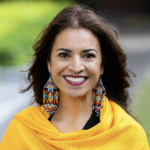
As a Xicana scholar with Rarámuri roots, I have learned from my parents how to be in good relations with lands and waters, and I have channeled that perspective into my research on mathematics, identity, power, and Indigenous futurity. Inspired by my relations with early founders of the Society for the Advancement of Chicanos and Native Americans in Science (SACNAS), I have also spent decades studying alternative ways to conceive of and teach mathematics.
We are told mathematics is universal, that 2 + 2 = 4 no matter where you go. Yet, there are not one but many mathematics. The history of mathematics and ethnomathematics show us that every culture and civilization developed mathematics by paying attention to the natural and spiritual worlds.
Researchers have chronicled vectors and triangulation used during Polynesian sea voyaging; fuzzy logic to gauge the health of seal colonies; and drag reduction in air/water interface based on a Kingfisher’s beak. These are some of the ways that humans developed mathematical practices in collaboration with the natural and spiritual worlds. Although design tools highlight these mathematical practices, ethnomathematics is not well known. Instead, modern Western mathematics prevails and tends to support domination and planetary destruction through an agenda of national security, warfare, and resource extraction. Data analytics and predictive algorithms (e.g., the likelihood of repeat offenders in crimes, diagnosing patients’ medical symptoms, mining sleep patterns to predict future consumer behavior) have had an especially negative impact on people of color and women.
These are the mathematics that got us to this moment. By quantifying, categorizing, and reducing complex and multi-layered relationships to mere abstractions, as if large language models will unravel objective truths, modern Western mathematics often supports the myth that modeling, big data, and software can solve anything. That is, the mathematics that got us to this moment is not the mathematics that will get us out.
So, what or who can help us move forward?
Beyond contributing the concept of zero or algebra, Indigenous peoples worldwide never forgot their interdependence with the natural world. By continuing to center relationality and reciprocity with the cosmos, they have intimate knowledge of ancestral intelligence and its evolution in our world. Ancestral intelligence does not live in algorithms; it lives in deep consensual relationships, observation, and storytelling; it is not easily captured by large language models mining internet data.
Indigenous perspectives highlight that plants and animals, winds and skies, waters and mountains, humans and more-than-humans, are always in relation, a form of ecology to which we all belong. Shorelines, ice and snow, as well as galaxies, expand through fractal patterns, the same patterns in tree branches and human vein systems, highlighting our interconnection. Ancestral intelligence functions on different time, scales, and modalities. That is, more than simply recognizing a fractal pattern, we can be touched by the fact that as we look to the night sky, the stars and patterns we see are not from our lifetime but connect us to our ancestors.
We are at a critical junction in human civilization. New mathematics can be developed and shared. But we must turn towards ancestral intelligence if we want mathematics to guide us to a healthier future. More than just developing guardrails, we should invest time and resources to learn from Indigenous nations and the patterns, structures, and logics that their lands and waters are teaching them. These nations would provide vision and leadership around how to center ancestral intelligence.
We can expand how we think about school mathematics by developing curricula that invite students to walk their lands, to learn mathematics in collaboration with nature, and then express their gratitude for those teachings. Computer programmers, in collaboration with Indigenous mathematicians, can insist that Large Language Models center different logics, ones that could lead us to focus on greater relationality.
This won’t be easy. But it’s doable. Our ancestors have walked these paths. The knowledge is all around us. We need to embrace it as we consider our collective futures.