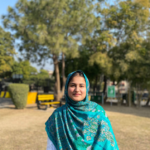
In the year 2026, a woman is still an object to be controlled. The recent murder of Rubina Chandio, in the name of so-called honor, in Burdo Chandio village adjacent to Tando Masti Police Station in Pakistan, reveals the truth of our society that a woman’s survival in a patriarchal system is inexorably linked to submission and bargaining.
The Night of Horror:
In the early hours of April 10, a police party on routine patrol receives information near the Faiz Wah stop that a woman is being assaulted. Upon arrival the police team witnesses four-armed men and an unarmed woman standing under the dim light of a mobile phone. Notwithstanding, the policemen’s arrival three of the men open fire and flee the space leaving Rubina with a bullet in her chest.
The video of this incident went viral and amassed a plethora of attention. The case has been registered on behalf of the state. An official investigation is underway under Khairpur SSP Ameer Suad Ahmed Magsi for a detailed report and arrest of the prime suspects Qaisar Chandio and Wali Muhammad. The murder of Rubina uncovers some of the vilest aspects of a patriarchal system.
Karo Kari and the Jirga:
The murder of Rubina is the direct consequence of the tradition of ‘Karo Kari’, the origins of which lie in the patriarchal tribal customs of Pakistan. A woman declared as ‘kari’ or ‘blackened woman’ is the one who has violated the honor of her family by forging illicit sexual relations and hence is destined to be killed to restore the family’s lost honor.
Although men are also killed in the pretext of this tradition when declared as Karo (blackened man), however the statistics entail that most of the population affected by this inhumane tradition comprises women with 470 cases being reported in 2021 alone.
In addition, this premeditated form of honor killing is sustained, and enacted mostly by the institution of Jirga, prevalent in the rural areas of Pakistan. The man of a Kari woman is expected to reply in two ways: “slaughter or Kick out” (Wadhi ya Kadhi in Sindhi Language). If a man does not take any action, then the jirga is arranged. In Rubina’s case, she married a man upon her own will, who after a week abandoned her which led Rubina back to her home and eventually to the grave as the Chieftain of the jirga declared her as Kari.
A deeper look at this tradition and its practice unveils the fact that honor of the family is ascribed to woman, which indicates that a woman cannot have any honor of her own. Society, hence, does not perceive women as an individual but as a mother, daughter, or a sister. She is killed because she violated her family’s honor. As deeply misogynistic this fact is it reveals the predominant mindset of the masses which do not see women as an individual but as somebody of some man.
Rubina, therefore, was not seen as a woman but as a daughter, and daughter only.
The question of women’s agency and autonomy, hence, comes into the equation. If a woman is not perceived as an individual, then she is not expected to possess any form of agency or autonomy. If she does so, she is guilty and punishable.
Here, Saba Mehmood’s “concept of agency” in which a woman willingly submits to traditions and customs does not apply since it is based on choice and not coercion. In the context of Pakistan, submission is the only option available to a woman and is regularized by the structures of the state which are primarily patriarchal in nature.
Patriarchy and a Woman’s agency:
In a patriarchal structure, every custom, every tradition, and every law sees woman as an object, a commodity whose agency is either absent or expressed in a permitted manner. Hence, the only way to survive is to accept the terms and conditions of patriarchy and to never exceed the limits defined by it.
In the scholarly traditions this act is known as ‘Patriarchal Bargain’ where women negotiate with patriarchy to optimize their status. Howbeit, the blueprint of each bargain is unique to the specific region where it takes place since the structures and forms of patriarchy are not monolithic and are expressed in different ways in different regions.
Therefore, Pakistan has its own specific form of patriarchy rooted in the religious and cultural milieu of the sub-continent. Kandiyoti denotes the structure of patriarchy in Pakistan as a “classic patriarchy” which operates based on a patrilineal family where the man of the household is the ultimate authority.
In this familial landscape, women must obtain security by employing various negotiating strategies i.e., marrying a man, birthing a son, or repressing any conjugal bond between son and daughter-in-law since she does not have any financial independence to express her individual agency and relies on her father, husband, or son. Thus, what occurs is that a slight transgression from the permissible path results in a cruel end. This transgression could only be her expressing her individuality as Rubina expressed hers by marrying of her own will instead of that of her patrilineal family.
To Bargain and live or to Rebel and die?:
The fundamental quandary here then is whether a woman should bargain with the patriarchy and secure a life of submission or rebel against the biased system and die a death of horror. Unfortunately, this is the dark alley that awaits each woman of this country no matter the class, caste, color, or religion.
If Rubina’s agency, in her marriage, is celebrated as a victorious rebellion against patriarchy, then how to see her death? As a necessary cost or as a promised effect. Should women be encouraged to express their individuality when this is the reality of our society? But living a life off a bargain within this discriminatory system is not a viable option either.
The horrific murder of Rubina is not just a case of honor killing but a case of the brutal end of a woman who expressed her agency in a rebellious manner and refused to bargain with the system. Bargaining, hence, is not the solution to the problem. Unless and until patriarchy is abolished and dismantled, every woman would live her life in this painful dilemma where both ends of the alley lead to despair.