
Homelessness continues to confound Republicans and Democrats alike. There are no easy fixes. No single policy will untangle it. What it does require is an open mind and the humility to admit a difficult truth. It could happen to almost anyone.
I don’t claim to have the answers. But I do have several years of lived experience on the sidewalks of New York City helping the homeless in small ways. And I’ve been blessed with witnessing one extraordinary transformation that proves change is possible.
Recently, Curtis Sliwa shared a heartbreaking update on his FaceBook page about the Guardian Angels’ efforts to help the homeless in New York during the bitter cold of 2026. I read it with great interest because this issue stopped being abstract for me in March 2020.
My husband and I were vacationing when COVID-19 shut down the world. Airports closed. Fear spread faster than the virus. We returned to Manhattan to a city emptied of its usual life. Many residents had fled. Others stayed behind their closed doors and shuttered windows.
But one group had nowhere to go: the men and women living on the streets.
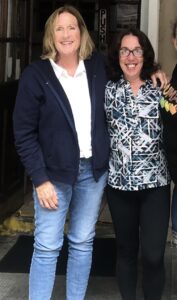
Author & Melissa Plush
It became clear almost immediately that they were hungry. When the city emptied, so did the small mercies that had sustained them. No commuters meant no spare change. No foot traffic meant no food. Empty sidewalks led to empty panhandling cups and to empty stomachs.
So we began making sandwiches. Day after day, for the remainder of 2020, we walked through a silent Manhattan handing them out. In that time, we came to know roughly fifty people by name. Not statistics. Not “the homeless.” People.
One of them was Melissa Plush. For three years, she slept on the corner of Park Avenue and 30th Street. Today, she lives indoors. She is employed. She returned to college and graduated. She was named Best of Brooklyn College, an honor bestowed on very few. Together, we co-authored two bestselling books.
People often ask us how we accomplished so much in such a short time. They expect a strategic blueprint or a funding model.
The truth is simple. But perhaps difficult to accept.
Resources matter. Shelter, treatment, and employment opportunities matter. But none of it gains traction without something more fundamental. Sustained human connection.
You cannot rehabilitate someone you do not see. You cannot restore dignity without first offering it.
What changed Melissa’s trajectory was not a program alone. It was relationship. And yes—love. Not sentimental love. Not charity from a distance. But the steady, stubborn love that refuses to let someone disappear. It was not easy for either of us. Melissa wanted to disappear, and I often wanted her to do so.
Homelessness is complex. But hopelessness is optional. The issue is vast. The solutions are difficult, but change begins the moment we stop looking away. As Melissa said in her Brooklyn College interview, “Traci did not just see a homeless woman. She saw me.”
If you want to understand what transformation can look like, read Melissa’s story in the Wall Street Journal and USA Todaybestseller, Unsheltered Love: Homelessness, Hunger, and Hope in a City Under Siege and its sequel, Chasing Light: Two Women, Their Mothers, and a Secret That Changed Their Lives.